Charles Dickens
Robert Louis Stevenson was a Scottish novelist, essayist, poet and travel writer. He is best known for the novels Treasure Island (1883), Strange Case of Dr Jekyll and Mr Hyde (1886), and Kidnapped (1886) and for the poetry collection A Child's Garden of Verses (1885).
Complete Bibliography
Follow the recommended order to not miss a thing.
Main Works
50 Books
The uncommercial traveller
A collection of seventeen sketches which grew out of Dickens' insomnia. He took long walks through London at night and his observations resulted in these sketches.
The Old Curiosity Shop
The sensational bestselling story of Little Nell, the beautiful child thrown into a shadowy, terrifying world, seems to belong less to the history of the Victorian novel than to folklore, fairy tale, or myth. The sorrows of Nell and her grandfather are offset by Dickens's creation of a dazzling contemporary world inhabited by some of his most brilliantly drawn characters—the eloquent ne'er-do-well Dick Swiveller; the hungry maid known as the "Marchioness"; the mannish lawyer Sally Brass; Quilp's brow-beaten mother-in-law; and Quilp himself, the lustful, vengeful dwarf, whose demonic energy makes a vivid counterpoint to Nell's purity.
A Child's History of England
IF you look at a Map of the World, you will see, in the left-hand upper corner of the Eastern Hemisphere, two Islands lying in the sea. They are England and Scotland, and Ireland. England and Scotland form the greater part of these Islands. Ireland is the next in size. The little neighbouring islands, which are so small upon the Map as to be mere dots, are chiefly little bits of Scotland, - broken off, I dare say, in the course of a great length of time, by the power of the restless water.
[Works
Dickens died before completing his last novel, leaving its mystery unsolved and encouraging successive generations of readers to try and work out what happened next.
Christmas Books (Battle of Life / Chimes / Christmas Carol / Cricket on the Hearth / Haunted Man)
A collection of five stories about Christmas by English author Charles Dickens.
The Chimes
A Goblin Story of Some Bells that Rang An Old Year Out and A New Year In.
No Thoroughfare
A Tale of Two Cities
A Tale of Two Cities is a historical novel published in 1859 by Charles Dickens, set in London and Paris before and during the French Revolution. The novel tells the story of the French Doctor Manette, his 18-year-long imprisonment in the Bastille in Paris, and his release to live in London with his daughter Lucie whom he had never met. The story is set against the conditions that led up to the French Revolution and the Reign of Terror. In the Introduction to the Encyclopedia of Adventure Fiction, critic Don D'Ammassa argues that it is an adventure novel because the protagonists are in constant danger of being imprisoned or killed. As Dickens's best-known work of historical fiction, A Tale of Two Cities is said to be one of the best-selling novels of all time. In 2003, the novel was ranked 63rd on the BBC's The Big Read poll. The novel has been adapted for film, television, radio, and the stage, and has continued to influence popular culture.
The Life and Adventures of Nicholas Nickleby
Nicholas Nickleby is left responsible for his mother and sister when his father dies. The novel follows his attempt to succeed in supporting them, despite his uncle Ralph's antagonistic lack of belief in him. It is one of Dickens' early comic novels.
Little Dorrit
Upon its publication in 1857, Little Dorrit immediately outsold any of Dickens's previous books. The story of William Dorrit, imprisoned for debt in Marshalsea Prison, and his daughter and helpmate, Amy, or Little Dorrit, the novel charts the progress of the Dorrit family from poverty to riches. In his Introduction, David Gates argues that "intensity of imagination is the gift from which Dickens's other great attributes derive: his eye and ear, his near-universal empathy, his ability to entertain both a sense of the ridiculous and a sense of ultimate significance.
David Copperfield
It adds to the charm of this book to remember that it is virtually a picture of the author's own boyhood. It is an excellent picture of the life of a struggling English youth in the middle of the last century. The pictures of Canterbury and London are true pictures and through these pages walk one of Dickens' wonderful processions of characters, quaint and humorous, villainous and tragic. Nobody cares for Dickens heroines, least of all for Dora, but take it all in al, l this book is enjoyed by young people more than any other of the great novelist. After having read this you will wish to read Nicholas Nickleby for its mingling of pathos and humor, Martin Chuzzlewit for its pictures of American life as seen through English eyes, and Pickwick Papers for its crude but boisterous humor.
Dombey and Son
Dombey and Son is both a firm and a family and the ambiguous connection between public and private life lies at the heart of Dickens' novel. Paul Dombey is a man who runs his domestic affairs as he runs his business: calculatingly, callously, coldly and commercially. Through his dysfunctional relationships with his son, his two wives, and his neglected daughter Florence, Dickens paints a vivid picture of the limitations of a society dominated by commercial values and the drive for profit andexplores the possibility of moral and emotional redemption through familial love.
Sketches by Boz
How much is conveyed in those two short words - 'The Parish!' And with how many tales of distress and misery, of broken fortune and ruined hopes, too often of unrelieved wretchedness and successful knavery, are they associated! A poor man, with small earnings, and a large family, just manages to live on from hand to mouth, and to procure food from day to day; he has barely sufficient to satisfy the present cravings of nature, and can take no heed of the future.
The Pickwick Papers
Dickens’ first novel was originally written and published as a serial. It is a comedy relating the misadventures of the members of The Pickwick Club, whose main purpose is to discover and relate quaint and curious phenomena of social life and customs throughout England. This quest takes the members to all parts of the country, travelling by coach and sampling the comforts or otherwise of various coaching inns.
Our Mutual Friend
*Our Mutual Friend* is a satiric masterpiece about money. The last novel Dickens completed, and perhaps his most angry, it sounds all the great themes of his later work: the innocence and venality of the aspiring poor, the hollow pretensions of the nouveau riche, the unfailing power of wealth to corrupt everyone it touches. Among those caught up in the ruthless forces of change in Dickens's London are the archetypal innocent Noddy Boffin, who 'inherits' a dustheap where the trash of the rich is thrown; Silas Wegg, a grotesque, one-legged man with unlimited fantasies of grandeur and power; Mr. Veneering, Member of Parliament, whose house, furnishings, servants, carriage, and baby are all 'bran-new'; and Alfred and Sophronia Lammle, who marry one another because each wrongly believes the other is rich. The social themes of *Our Mutual Friend*--having to do with the treatment of the poor, education, representative government, even the inheritance laws--are informed and brought into cohere
Martin Chuzzlewit
The greed of his family has led wealthy old Martin Chuzzlewit to become suspicious and misanthropic, leaving his grandson and namesake to make his own way in the world. And so young Martin sets out from the Wiltshire home of his supposed champion, the scheming architect Pecksniff, to seek his fortune in America. In depicting Martin's journey – an experience that teaches him to question his inherited self-interest and egotism – Dickens created many vividly realized figures: the brutish lout Jonas Chuzzlewit, plotting to gain the family fortune; Martin's optimistic manservant, Mark Tapley; gentle Tom Pinch; and the drunken and corrupt private nurse, Mrs Gamp. With its portrayal of greed, blackmail and murder, and its searing satire on America Dickens's novel is a powerful and blackly comic story of hypocrisy and redemption.
American notes
Description of a trip by the famous British novelist Charles Dickens to the U.S. in the early 1840s, which included travel through the Great Lakes states. The first and last portions of the book are accounts of his travel in the east. There are also chapters on slavery and his voyage back to England. Chapter headings for the portion on western travel are: -From Pittsburg to Cincinnati in a western steam-boat. Cincinnati. -From Cincinnati to Louisville in another western steam-boat; and from Louisville to St. Louis in another. St. Louis. -A Jaunt to the Looking-glass prairie and back. -Return to Cincinnati. A stage-coach ride from that city to Columbus, and thence to Sandusky. So, by Lake Erie, to the Falls of Niagara.
Works (American Notes / Pictures from Italy)
American Notes was the result of the author's five-month trip to America in 1842. Dickens's travelogue includes the glitter of Boston; a Broadway swarming with hogs; a gruesome penitentiary in Philadelphia; Cincinnati, Louisville, and St. Louis; railways and steamboats. Its publication was greeted with dismay: what Dickens described as "honest and true" was regarded in America as "a compound of egotism, coxcombry and cockneyism", the product of "the most coarse, vulgar, impudent and superficial" writer ever to visit the country. Pictures from Italy is a colorful account of a tour made in 1844. - Jacket flap.
The Moonstone
One of the first English detective novels, this mystery involves the disappearance of a valuable diamond, originally stolen from a Hindu idol, given to a young woman on her eighteenth birthday, and then stolen again. A classic of 19th-century literature.
Oliver Twist
Oliver Twist; or, The Parish Boy's Progress, is the second novel by English author Charles Dickens. It was originally published as a serial from 1837 to 1839, and as a three-volume book in 1838. The story follows the titular orphan, who, after being raised in a workhouse, escapes to London, where he meets a gang of juvenile pickpockets led by the elderly criminal Fagin, discovers the secrets of his parentage, and reconnects with his remaining family. Oliver Twist unromantically portrays the sordid lives of criminals, and exposes the cruel treatment of the many orphans in London in the mid-19th century. The alternative title, The Parish Boy's Progress, alludes to Bunyan's The Pilgrim's Progress, as well as the 18th-century caricature series by painter William Hogarth, A Rake's Progress and A Harlot's Progress. In an early example of the social novel, Dickens satirises child labour, domestic violence, the recruitment of children as criminals, and the presence of street children. The nove
Barnaby Rudge
Set against the backdrop of the Gordon Riots of 1780, Barnaby Rudge is a story of mystery and suspense which begins with an unsolved double murder and goes on to involve conspiracy, blackmail, abduction and retribution. Through the course of the novel fathers and sons become opposed, apprentices plot against their masters and Protestants clash with Catholics on the streets. And, as London erupts into riot, Barnaby Rudge himself struggles to escape the curse of his own past. With its dramatic descriptions of public violence and private horror, its strange secrets and ghostly doublings, Barnaby Rudge is a powerful, disturbing blend of historical realism and Gothic melodrama.
Master Humphrey's Clock
*Master Humphrey's Clock* was an ambitious weekly literary magazine published by Dickens himself. Lasting only from 1840 to 1841, it spun off some major works, including *The Old Curiosity Shop* and this collection of stories and sketches. The narrator is Master Humphrey , not "churlish" and not a "misanthrope", who describes his daily life and his encounters with vivid characters including Mr. Pickwick. The clock is his old companion, where he stores manuscripts.
A Christmas Carol
A retelling of the story about a miser whose life is changed by Christmas.
The Battle of Life
Once upon a time, it matters little when, and in stalwart England, it matters little where, a fierce battle was fought. It was fought upon a long summer day when the waving grass was green. Many a wild flower formed by the Almighty Hand to be a perfumed goblet for the dew, felt its enamelled cup filled high with blood that day, and shrinking dropped. Many an insect deriving its delicate colour from harmless leaves and herbs, was stained anew that day by dying men, and marked its frightened way with an unnatural track.
Novels (Chimes / Christmas Carol / Cricket on the Hearth)
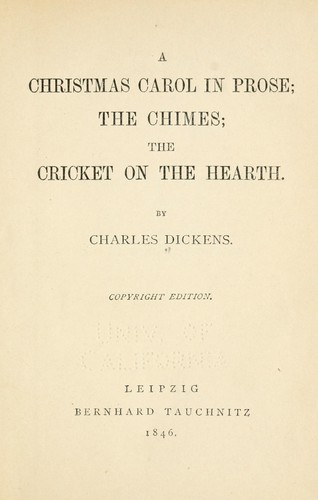
A Christmas carol; The chimes; The cricket on the hearth.
The Cricket on the Hearth
One of Charles Dickens' Christmas Books John Peerybingle, a carrier, lives with his young wife Dot, their baby boy and their nanny Tilly Slowboy. A cricket chirps on the hearth and acts as a guardian angel to the family. One day a mysterious elderly stranger comes to visit and takes up lodging at Peerybingle's house for a few days.
Pictures from Italy
From the book:If the readers of this volume will be so kind as to take their credentials for the different places which are the subject of its author's reminiscences, from the Author himself, perhaps they may visit them, in fancy, the more agreeably, and with a better understanding of what they are to expect. Many books have been written upon Italy, affording many means of studying the history of that interesting country, and the innumerable associations entwined about it. I make but little reference to that stock of information; not at all regarding it as a necessary consequence of my having had recourse to the storehouse for my own benefit, that I should reproduce its easily accessible contents before the eyes of my readers.
The Haunted Man and the Ghost's Bargain
In this story, Dickens narrates the hair-raising experiences of a professor. As the protagonist dwells on his past sorrows and mistakes, a phantom visits him. It offers him a bizarre escape from painful recollections of yesteryear by offering to eradicate his memory. On seeing the professor turn into a man devoid of emotions, the reader realizes how empty one becomes without a past.
David Copperfield [1/2]
Bleak House
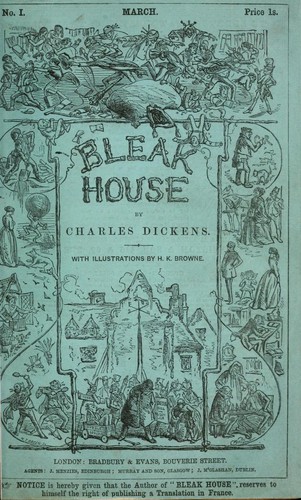
As the interminable case of Jarndyce and Jarndyce grinds its way through the Court of Chancery, it draws together a disparate group of people: Ada and Richard Clare, whose inheritance is gradually being devoured by legal costs; Esther Summerson, a ward of court, whose parentage is a source of deepening mystery; the menacing lawyer Tulkinghorn; the determined sleuth Inspector Bucket; and even Jo, the destitute little crossing-sweeper. A savage, but often comic, indictment of a society that is rotten to the core, Bleak House is one of Dickens's most ambitious novels, with a range that extends from the drawing rooms of the aristocracy to the poorest of London slums.
Hard Times
Dickens scathing portrait of Victorian industrial society and its misapplied utilitarian philosophy, Hard Times features schoolmaster Thomas Gradgrind, one of his most richly dimensional, memorable characters. Filled with the details and wonders of small-town life, it is also a daring novel of ideas and ultimately, a celebration of love, hope, and limitless possibilities of the imagination.
The Seven Poor Travellers
The Holly Tree
A collaborative piece produced for the Christmas season. Musings of a self-described "bashful man" when he is snowed in at the Holly Tree Inn.
The Haunted House
The drama begins with a Yuletide gathering in an eerie country retreat that's rumored to be haunted. There, Dickens and his friends, including acclaimed authors Elizabeth Gaskell and Wilkie Collins, take on the task of finding evidence of a supernatural presence in the house. When they reconvene at a Twelfth Night feast to review their findings, what will their stories reveal?
The Woman in White
The Woman in White famously opens with Walter Hartright's eerie encounter on a moonlit London road. Engaged as a drawing master to the beautiful Laura Fairlie, Walter is drawn into the sinister intrigues of Sir Percival Glyde and his 'charming' friend Count Fosco, who has a taste for white mice, vanilla bonbons and poison. Pursuing questions of identity and insanity along the paths and corridors of English country houses and the madhouse, The Woman in White is the first and most influential of the Victorian genre that combined Gothic horror with psychological realism.
Great Expectations
Great Expectations is the thirteenth novel by Charles Dickens and his penultimate completed novel. It depicts the education of an orphan nicknamed Pip . It is Dickens' second novel, after David Copperfield, to be fully narrated in the first person. The novel was first published as a serial in Dickens's weekly periodical All the Year Round, from 1 December 1860 to August 1861. In October 1861, Chapman and Hall published the novel in three volumes. The novel is set in Kent and London in the early to mid-19th century and contains some of Dickens's most celebrated scenes, starting in a graveyard, where the young Pip is accosted by the escaped convict Abel Magwitch. Great Expectations is full of extreme imagery – poverty, prison ships and chains, and fights to the death – and has a colourful cast of characters who have entered popular culture. These include the eccentric Miss Havisham, the beautiful but cold Estella, and Joe, the unsophisticated and kind blacksmith. Dickens's themes include
Doctor Marigold
Originally published in 1865, Doctor Marigold was extremely successful, as were Dickens's public performances of a play based on the story--fascinating and easy to read. Doctor Marigold is a "Cheap Jack" or what we would call a street peddler. Doctor Marigold's fortunes reverse when he adopts a deaf and mute girl whose mother is dead and whose stepfather, owner of a traveling circus, beats her. Dr Marigold recalls an overwhelming passion across two cultures--hearing and deaf.
The mystery of Edwin Drood
The Mystery of Edwin Drood is the final, uncompleted novel by Charles Dickens. John Jasper is a choirmaster who is in love with one of his pupils, Rosa Bud. She is the fiancee of his nephew, Edwin Drood. A hot-tempered man from Ceylon also becomes interested in her and he and Drood take an instant dislike to one another. Later, Drood disappears, and as Dickens never finished the novel, Drood's fate remains a mystery indeed.
The lock and key library
Magic Fishbone
Originally subtitled: A Holiday Romance from the Pen of Miss Alice Rainbird, Aged 7 An original fairy tale about a large royal family , a sensible princess heroine, and a take-no-nonsense fairy godmother.
A Christmas Tree
Perhaps best described as Charles Dickens's other' Christmas story, "A Christmas Tree" is an elderly narrator's reminiscence of holidays past, each incident inspired by the gifts and toys that decorate the traditional tree. There is a range of appeal in the story itself, from snug memories of beloved toys to the passing along of eerie stories surrounding various childhood haunts. This sweet short story told from the Christmas tree's point of view is one of the best Christmas stories ever told. Christmas has not always been a public holiday; before the mid-1800s, it was primarily a religious celebration enjoyed by the wealthy. It was during Victorian times in Britain that Christmas became a national holiday and that many of the traditions. If there is one figure who shaped Christmas as we know it today, it is the author Charles Dickens. His seasonal short stories and books, and particularly his novella A Christmas Carol and A Christmas Tree published at the height of his popularity in 1
The Life of Our Lord
**In this charming, simple retelling of the life of Jesus Christ, adapted from the Gospel of St. Luke, Dickens hoped to teach his young children about religion and faith.**---Goodreads **The author of such works as "Oliver Twist" and "A Christmas Carol" retells the story of Jesus Christ, for his own children.**--LibraryThing
The Signal-man
Oliver Twist [adaptation]
Retells the adventures of the orphan boy who is forced to practice thievery and live a life of crime in nineteenth-century London.
A Tale of Two Cities [adaptation]
Grade 3 Vocabulary restricted to 3,100 headwords Illustrated in colour Lucie thinks that her father, Dr. Manette, is dead. Then one day a stranger tells her that Dr. Manette is alive - he has been in the terrible Bastille prson in Paris for many years and has just been released. In Paris, Lucie finds her father being cared for by a loyal ex-servant, Defarge, and his wife. Poor Dr Manette goes back to England with Lucie. A few years later, when Dr. Manette and Lucie return to Paris, everything has changed. The French Revolution has begun, and the poor people are killing the noblemen. Lucie's husband the kind Charles Darnay, is the heir of some of the cruellest noblemen, and the Defarges are now plotting to destroy him. Only love and great courage can save him...
Hunted Down
Iki Sehrin Hikayesi
Three Ghost Stories
Trial for Murder
One of Dickens's standalone ghost stories, of which he was so fond. Here the unnamed narrator is also selected as the foreman of the jury where the accused is being tried for murder. There is, among the jury, an unseen thirteenth juror, whose presence is certainly felt by the accused, by witnesses, by the prosecutor and by the judge himself. When the verdict is pronounced, the guilty man declares that the the trial was an unfair one, that the foreman of the jury was dead against him...